Self-doubt and studio frames
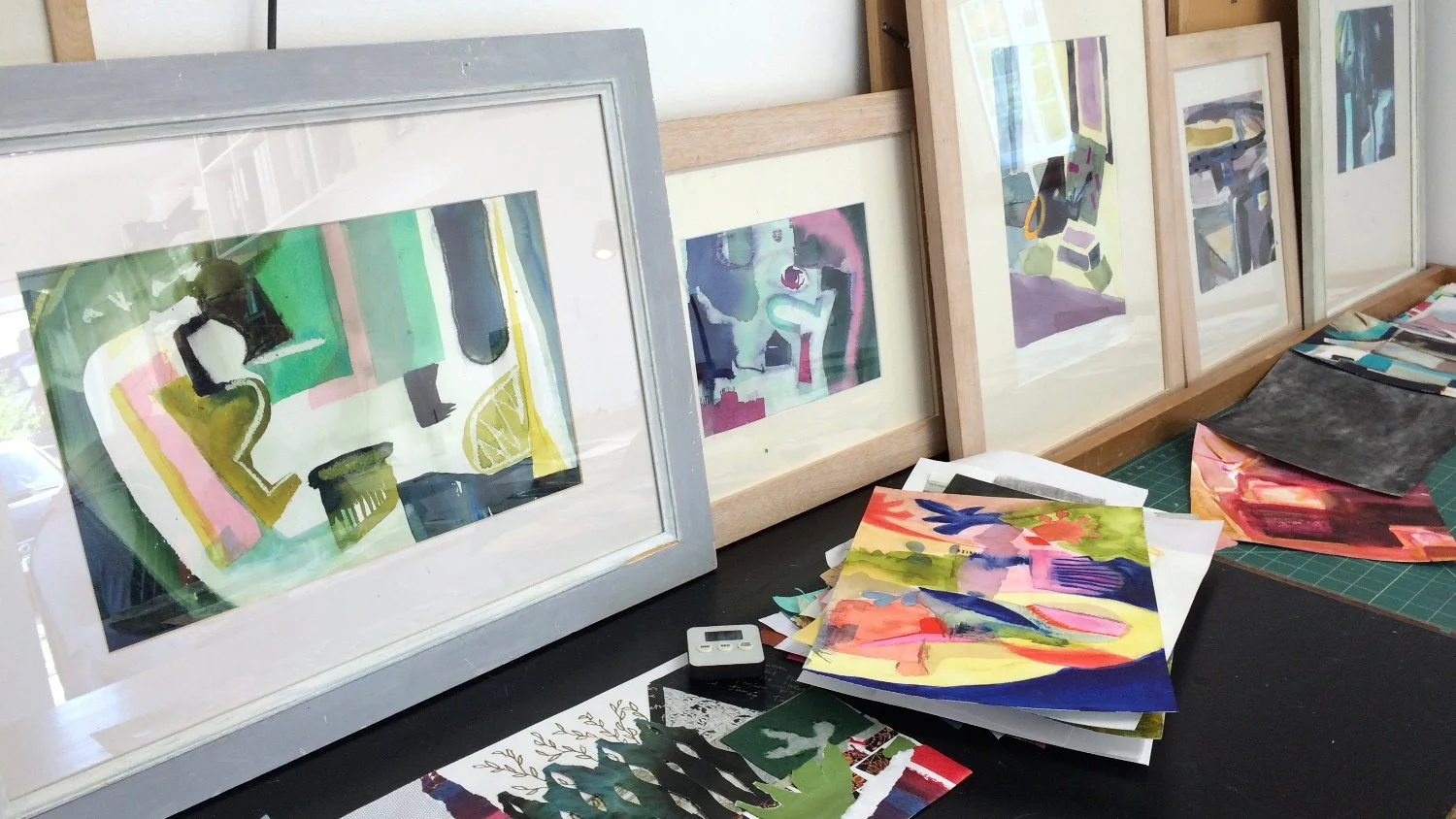
Framed abstract watercolours by students in Observation to Abstraction workshops 2016
Creative self-doubt in painting
When we're in the middle of painting, we often struggle to see what's really happening on the painting surface. What we imagine in our heads for a painting is never what appears. There is always a gap between intention and realisation, for artists at all stages of experience. We get lost between our idealised mental image of the painting, and the moves we make that don't work as intended, the unexpected accidents, deciding what to keep and what to erase, and the unnerving sense of not knowing what's happening as we paint.
And because we feel we don't know what we're doing, we fear that we're not much good at this after all. This is understandable. But we cannot let it take hold, because If we knew exactly what we were doing and how it would turn out, it probably wouldn't be art. Art is not a recipe.
Framing work in progress as part of studio practice
Everyone suffers from this creative self-doubt though. You are not alone if you do. It's normal. It's uncomfortable and it can make you devalue your work and castigate yourself.
One of the ways I address this is to put participants' work into studio frames at the end of every art class. It's often felt that the frame mysteriously improves the painting. But the frame just reveals what we've actually got.
I began to use studio frames for my own work over twenty years ago, when I was learning to paint with Robin Child. These frames have quick-release clips at the back so that paintings can be tried out in them rapidly. He insisted that the frames were part of the learning experience, and that they were the best way to learn to discriminate between stronger and weaker work.
I found this out for myself with two paintings at the end of one particular day. I felt one painting was working rather well, and the other hardly worth putting in a frame. But, following Robin's instructions, I put each in a frame, and propped both up on a kitchen shelf, side by side.
Over the course of about a week, the one I'd been confident about somehow receded. And I watched as the one I'd thought was a hopeless case came forward, or came info focus. It gradually emerged as the stronger and fresher painting. The frames allowed me to see what I'd actually got. And to become more dispassionate in assessing which paintings to choose for exhibition.
Learning to assess your paintings
Sometimes the frame reveals why the painting isn't resolved. It helps us see a final move or a correction we need to make. The frame simply helps us see with fresh eyes, both what we've achieved and what is still to do.
The frame also helps with knowing when to stop. Most paintings are finished six minutes, six hours, or six weeks before the artist actually gives up. But put an 'unfinished' painting in a temporary frame, and sometimes, often, the frame reveals that the painting is finished enough. Or closer to being finished than you thought. Adding more will change the painting, certainly, but not necessarily improve it. More is not always more.
Sometimes the frame renders a painting so unfamiliar to the artist that they don't recognise their own work. It happens predictably often in my teaching studio that someone says, "Wow, who did that one?', unknowingly pointing at one of their own paintings.
Sometimes we can only see a painting's strengths when we think it isn't ours. Using frames might be a blunt instrument for this. Recognising and appreciating that your painting is working successfully is, for some artists, the hardest step. It's one of the more subtle but more important aims of my art workshops.